The future of functional beverages
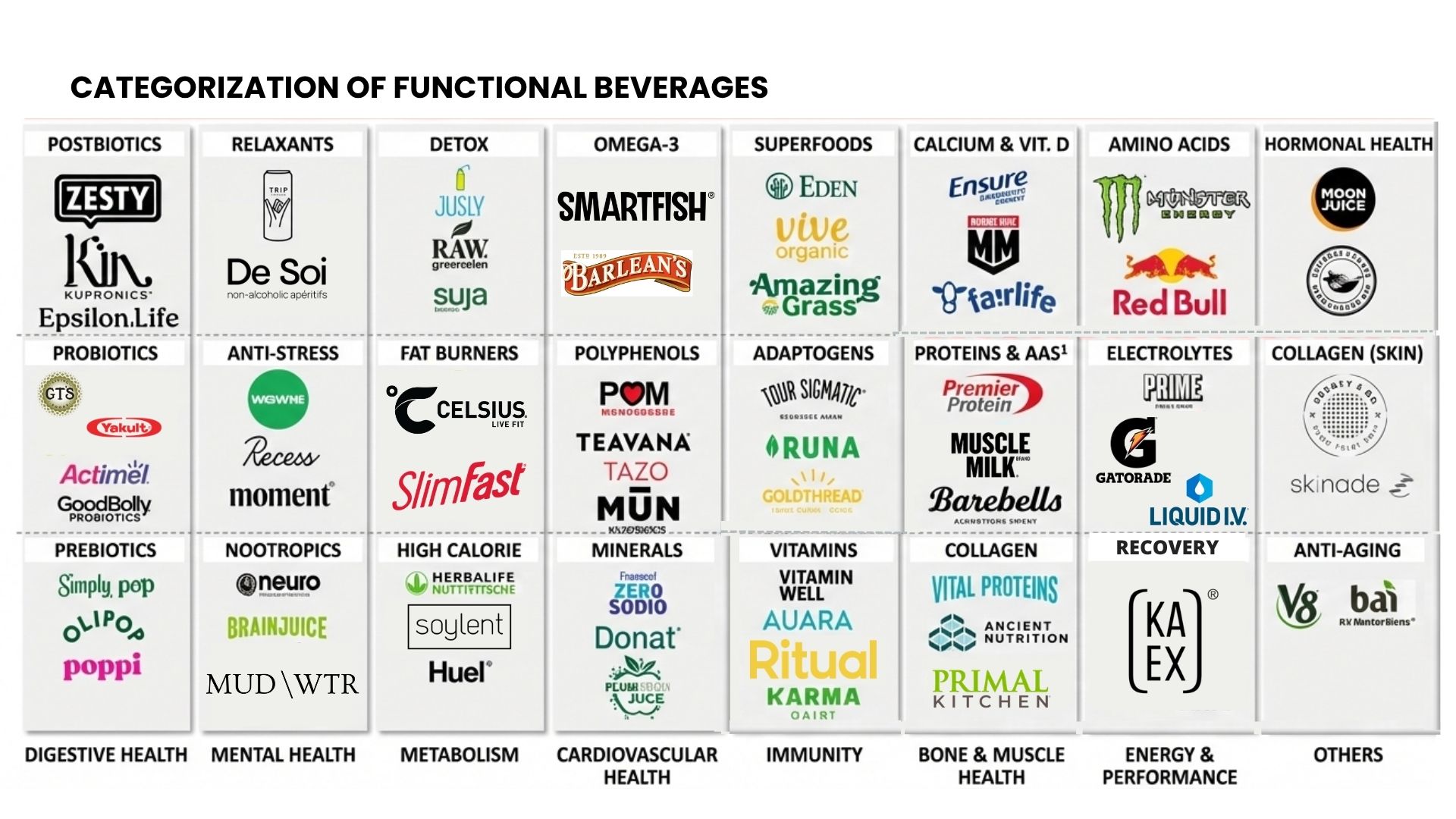
Walk down the beverage aisle, and you’ll notice something odd: the organizing principle isn’t flavor anymore. It’s health function-based. “Gut.” “Calm.” “Focus.” “Immunity.”
The labels read less like refreshment and more like a gentler version of the health-supplement shelf. Consumers increasingly shop for beverages the way they shop for over-the-counter drugs: By the benefit they're seeking.
This purchase behavior is no longer fringe. Mordor Intelligence estimates North American functional beverage sales at around $58.0 billion in 2025 and projects them at around $82.85 billion by 2031. SPINS pegs the digestive health beverage category at $1.18 billion and an increase of around 22% from 2023, a clear example of a function becoming a sub-aisle.
Consumers as savvy CEOs
A quantified-self mindset has trained consumers to expect data-backed ingredients, transparent dosing, and credible substantiation. Capital followed attention. "Consumers are becoming the CEOs of their own health," as Deloitte explains.
Publicly disclosed growth rounds into a small set of functional (and functional-adjacent) brands since 2021 already exceed $300M:
- Olipop ($30 million in 2022, then $50 million in 2025)
- Poppi ($25 million in 2022)
- Recess ($30 million in 2025)
- TRIP ($40 million in 2025)
- Hiyo (~$19 million in 2025)
Plus “better-for-you” neighbors like Athletic Brewing ($50 million in 2024, according to Bevnet) and Liquid Death ($67 million in 2024, according to Bevnet). That’s a floor, not a full market total.
And incumbents aren’t only buying, they’re upgrading legacy flagships into indulgences with benefits. Pepsi launched Pepsi Prebiotic Cola. Coca-Cola launched Simply Pop, its own prebiotic soda under a trusted master brand.
For challengers, offering a benefit won’t be enough. In crowded need states, winners will need a distinctive formulation, defensible claims, packaging, and positioning that lead consumers to choose them even when a familiar giant offers a cheaper, "good-enough" alternative.
Trust is the choke point. As claims rise, scrutiny rises as well. Poppi’s gut-healthy claims drew a class-action suit and ended in an $8.9 million settlement. A separate class action was filed against Olipop in late 2025, challenging digestive-benefit advertising. In a pharmacy-like aisle, credibility becomes the scarce resource.
The road to Beverage 3.0
If Beverage 1.0 was convenience and Beverage 2.0 was lifestyle, Beverage 3.0 is repeatable health benefits.
Brands that outperform build a repeatable foundation of belief by creating science-backed products with proven efficacy, strong potency, and stability, while reinforcing trust through community engagement and credible validation.
They pair the above with disciplined execution. This includes excellent distribution, modern go-to-market capabilities across social, search, and retail marketing, and targeted, strategically deployed total video campaigns.
Beverage 3.0 has given rise to players like KA-EX and GOOD IDEA that combine precision at the formula and delivery mechanism level. At the formula level, studies have shown KA-EX to lower cortisol -- 36% within 48 hours, improve HRV (+10%) and Sleep Score (15%), as several studies conducted in partnership with the Swiss National Football Team and PRUVN show.
Its patented VICAP dual-chamber cap sits atop the bottle to house sensitive bioactives in a dry, airtight environment. This prevents the rapid degradation that typically occurs over time in liquid, especially in acidic pH environments, ensuring ingredients like Phosphatidylserine - the primary cortisol-reducing bioactive - remain at peak strength until the moment of activation.
When launching in the U.S., the company secured up $6 million media-for-equity investment from mediaforgrowth, leveraging large-scale visibility and education to highlight its clinically grounded benefit claims and differentiate itself from unsubstantiated “greenwashed” claims that crowd the category.
GOOD IDEA is an independent functional water brand that leans more on science than most newer players. Instead of just making claims about its ingredients, the company points to gold standard human clinical trial on the drink itself, showing it can help reduce blood sugar spikes after meals.
Successful Beverage 3.0 companies are science-backed, built around clear need states, and powered by strong communities that earn consumer trust through the most effective mix of social and trusted mass media.
In the future, we can look forward to Beverage 4.0, which will bring more tailored-made formulations that address multiple consumer needs and will be tied to measurement platforms and feedback loops.
The original article is a featured article in Fast Company